
Guided Living™: How We Care for Your Loved One at Home
Most home care comes down to a task list. Someone arrives, helps with a shower, makes lunch, and leaves. The tasks get done, but nobody is watching the bigger picture, and nobody tells you what they noticed.
Guided Living™ is our answer to that. It is the structured approach every LiveBetter at Home caregiver is trained in, and it shapes how we plan care, what our caregivers pay attention to during a shift, what gets written down, and how often you hear from us.
Guided Living™ is not an add-on or an upgrade. It is how we approach care every day, for every client in Edmond, Oklahoma City, and the surrounding communities.

What is Guided Living™?
Guided Living™ is LiveBetter at Home’s structured approach to helping someone age safely, independently, and confidently at home.
It works by focusing on five areas of daily life that determine whether staying at home continues to work over the long term: safety and stability, function and independence, cognition and routine, emotional and social well-being, and family confidence.
Most declines at home are slow. Someone eats a little less. They get up at night more often. They stop calling a friend they used to call every week. Each change on its own looks like nothing. Together, over a few months, they are the reason a family ends up making a decision in an emergency room instead of at a kitchen table.
By supporting all five areas at once and writing down what changes, we help keep small issues from becoming major setbacks.
Do with, not for
The core principle of Guided Living™ is simple: do with, not for.
It is faster for a caregiver to button a shirt than to wait while someone does it themselves. It is easier to bring a meal to a chair than to walk with someone to the table. But every task a person stops doing is a skill they begin to lose, and independence is usually lost in small pieces rather than all at once.
Our caregivers are trained to encourage participation and provide exactly the level of support someone actually needs, which may be different today than it was last week. That takes more patience than doing it for them. It is also the difference between helping someone live at home and simply managing them there.


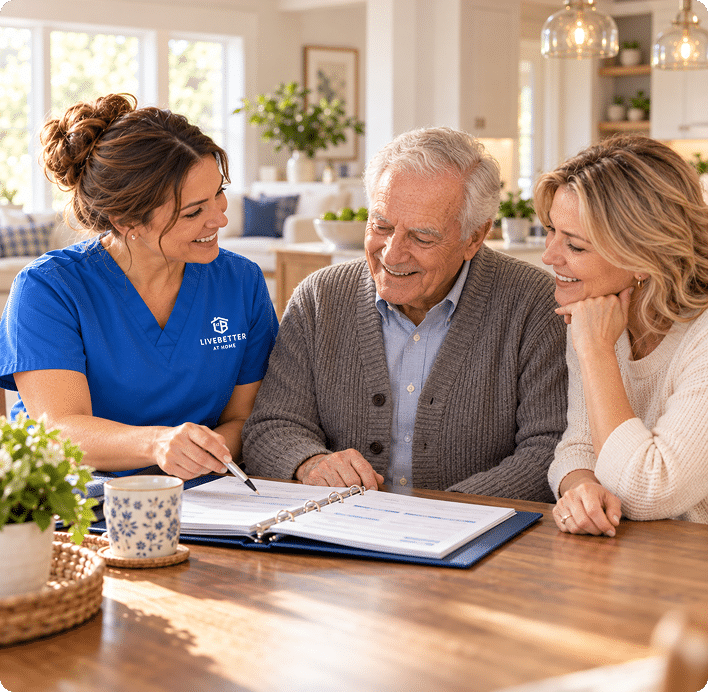
Guided Living™ is not a philosophy that lives in a brochure. It lives in a binder that stays in your loved one's home.
The Guided Living™ Journal is where the approach becomes a daily practice. Every caregiver reads it before a shift and writes in it before leaving. Over time it becomes the single shared record of your loved one’s care, and it answers a question most families cannot answer about the care their parent is receiving: what actually happened, and what changed.
Inside the Journal:
- A daily checklist, one per shift, covering all five pillars, so care stays consistent no matter which caregiver is working
- Who your loved one is, including the things every caregiver needs to know about them, their preferences, their history, and what matters to them
- Medical history, allergies, and a current medication list, kept in one place and ready to take to every physician appointment
- A monthly trend review tracking weight, meals, fluids, sleep, pain, mood, social contact, and falls across the weeks
- A weekly supervisor review rating each of the five pillars and noting whether things are better, the same, or worse
- A family page for the people in your loved one’s circle, upcoming appointments and events, and the wins worth celebrating
The Journal is a living document. It changes as needs change, and it belongs to your family.
How We Keep Your Family Informed
One of the hardest parts of arranging care is not knowing what is happening in between visits. Guided Living™ sets clear expectations so you are never guessing.
Routine updates
- Notes in the Journal after every shift
- A weekly supervisor review, rating each of the five pillars and whether things are improving, holding steady, or declining
- A monthly trend review covering the slower changes that daily notes can miss
- A quarterly care conference
We call the same day for a fall even without injury, a new symptom or warning sign, a medication change or missed dose, refused care or meals, or a change in schedule or caregiver.
We call right away if 911 is called, if there is an ER visit or hospital admission, a serious injury, a missing client, or any safety emergency.
We also ask how you want to be reached, who the backup contact is, and when not to call. Those preferences go in the Journal so every member of the team follows them.

The Five Pillars of Guided Living™
Safety and Stability
Preventing falls, maintaining a safe home environment, and noticing early warning signs.
A fall is the event that most often ends independence at home, and most falls are preventable. Our caregivers check the things that cause them: clutter in walkways, poor lighting, loose rugs, unsafe footwear, an assistive device that is not being used correctly. They watch how someone moves and whether it has changed.
This pillar also covers safe transfers, infection control, skin checks, and condition-specific precautions, which look different for someone with Parkinson’s than for someone with heart failure or diabetes.
Function and Independence
Encouraging participation in daily activities and supporting safe movement.
This is where do with, not for lives. Our caregivers look for what someone can still do and build the visit around keeping those abilities, rather than taking over. That includes mobility, activity, and the daily tasks that keep a person feeling like themselves.
Nutrition and hydration belong here too. Eating and drinking less is one of the earliest and most commonly missed signals that something has changed.
Cognition and Routine
Maintaining structure and providing the right reminders.
Familiar patterns do real work for someone experiencing memory changes. A predictable sequence to the day reduces confusion, lowers anxiety, and makes it easier to notice when something is actually different rather than just a bad morning.
Our caregivers follow the daily routine consistently across shifts, provide memory and orientation support as needed, and track patterns like late-day confusion so the family and the care team can see them clearly.
Emotional and Social Well-Being
Meaningful engagement and genuine connection.
Isolation is not a soft problem. It affects appetite, sleep, motivation, and willingness to accept care. A caregiver who knows that someone used to play bridge every Thursday, or who their grandchildren are, or what music they grew up with, can do something with that.
We document what a person actually enjoys and build engagement around it, and we track social contact the same way we track anything else that matters.
Family Confidence
Clear communication, reported changes, and shared decisions.
This pillar exists because a family that does not know what is happening cannot help, cannot plan, and cannot rest. We treat keeping you informed as part of the care itself rather than a courtesy we extend when there is time.
That means defined communication expectations, a weekly review you receive, and a clear record of who was told what and when.
A Care Plan That Changes With You
No two situations are alike, and no situation stays the same.
Guided Living™ starts with a conversation about what your loved one can do, what has become difficult, what they enjoy, and what matters most to your family. From there we set goals in each of the five pillars, specific to them.
Then we watch. Daily notes, weekly reviews, and monthly trends show us what is working and what is not, and the plan gets adjusted. A care plan written at the start of service and never revisited stops describing the person it was written for within a few months. Ours is built to keep up.
Our Caregivers Are Trained in Guided Living™
A framework is only as good as the people using it. Every LiveBetter at Home caregiver is trained in Guided Living™ as part of onboarding, with ongoing training after that.
They learn what to observe in each of the five pillars, how to recognize early warning signs and which of the three response levels applies, how to support independence rather than take over, how to handle difficult moments with patience and dignity, and how to document clearly enough that the next caregiver and your family can rely on it.
Our caregivers are background-checked and supported by a team that answers calls 24 hours a day. Guided Living™ is also one of the reasons caregivers choose to work here: it tells them what to look for and what matters, instead of handing them a task list and hoping for the best.
The Guided Living™ Early Warning System
Most health emergencies give small signals first.
An older adult often does not show illness the way a younger person does. There may be no fever and no chest pain. Instead there is new confusion, eating less, sleeping more, or a little more shortness of breath. New confusion by itself is sometimes the only sign of an infection.
The problem is that nobody sees the whole picture. Different caregivers work different shifts. Family visits on weekends. Each person sees one moment and has nothing to compare it to.
The Guided Living™ Early Warning System solves that by writing it down.
It starts with a baseline
Three clear levels of response
Our caregivers are trained to sort what they see into one of three responses, so nobody has to guess:
- Watch. A small change. Write it down, keep checking, and tell the next shift.
- Call today. A clear change from baseline. Call the nurse, supervisor, or doctor the same day.
- Call 911. A red flag. Call emergency services first, then the supervisor and the family.
Condition-specific signs
What counts as a warning sign depends on the condition. A two to three pound weight gain in a day means something specific in heart failure. Sudden increased confusion means something specific in dementia. Freezing episodes and choking at meals mean something specific in Parkinson’s.
The Journal includes condition-specific guidance for heart failure, COPD and lung disease, diabetes, dementia, kidney disease, Parkinson’s disease, and stroke or heart disease history, along with recognition steps for stroke and low blood sugar, where minutes matter.
What this means for your family
Our caregivers are not nurses. They do not diagnose, treat, or prescribe. What they do is notice, write it down, and tell the right person quickly.
That is the point. When a change is caught early and reported clearly, it reaches a nurse or physician sooner, with a written record of what changed and when, rather than being noticed weeks later by someone trying to remember.
Guided Living™ Across Our Services
Guided Living™ shapes every service we provide:
Talk With Our Team
If you are trying to figure out what your parent needs, or whether home care is the right next step, we are glad to talk it through. There is no cost for the conversation and no obligation.
Call us at (405) 461-6175 or request a care consultation.